> ## Documentation Index
> Fetch the complete documentation index at: https://docs.helpgenie.ai/llms.txt
> Use this file to discover all available pages before exploring further.
# Notification Channels
> Get pinged when a genie does something — every channel type, every field, explained.
Notification channels are how *you and your team* find out what a genie did — not something the genie itself uses. They're separate from [connections](/sync-guide/connections) because they need different permissions, and separate from [post-call actions](/sync-guide/post-call-actions) because those are things the genie does, while a notification is something that tells you about it.
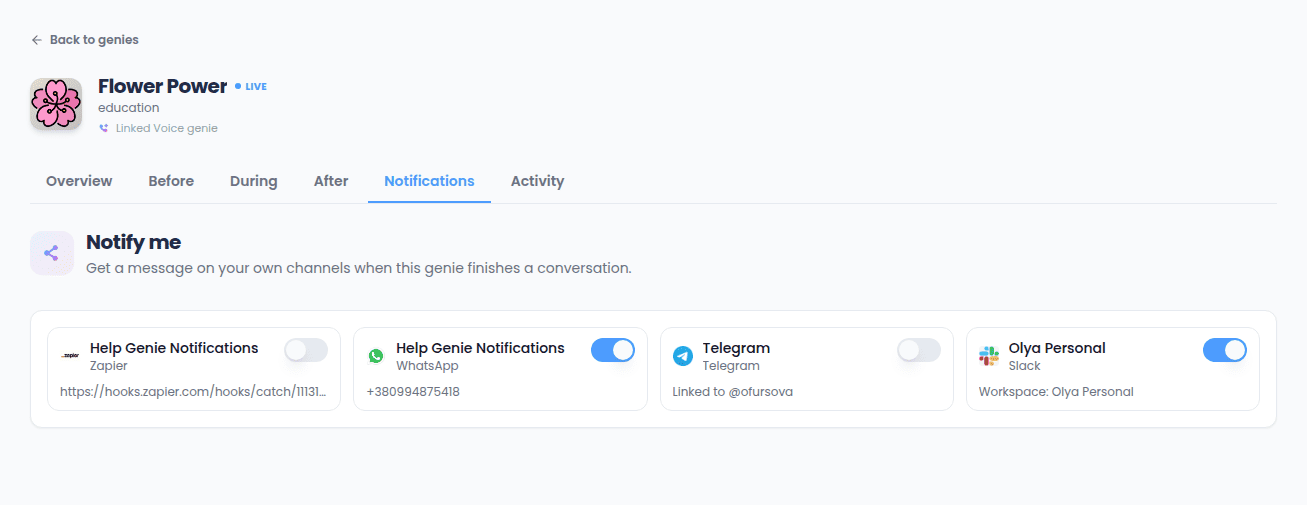
Setup happens once, account-wide, on the **Notification Channels** tab of the Connections page. After that, you turn each channel on or off per genie from that genie's own **Notify me** tab.
 ## The five channel types
### Slack
No fields to fill in — click to connect, sign in to Slack, and approve access. Sync can then post messages and share files in the channels you allow.
### Telegram
No fields to fill in. Instead, Sync gives you a link that opens Telegram and starts a conversation with the Sync bot. Open the link, tap start, and the connection completes automatically on Sync's end — nothing to copy or paste.
### WhatsApp
One field: **your WhatsApp number**, in international format starting with `+` (for example, `+14155551234`).
WhatsApp notifications currently run through a shared testing number rather than your own business number, which means there's a one-time extra step: you need to send a specific join message to that number from your WhatsApp before notifications will reach you, and you may need to repeat that step if you haven't received anything from it in a while. The exact message and number to use are shown on the setup screen.
### Zapier
Two fields:
* **Webhook URL** (required) — the Zapier webhook address that starts your Zap. Must be an `https://` address.
* **Signing secret** (optional) — if you set one, every request Sync sends is signed with it so you can verify on your end that it genuinely came from Sync, instead of sending the secret itself in each request.
### Make
Same two fields as Zapier — a required `https://` **webhook URL** and an optional **signing secret** — just pointed at a Make scenario instead.
## Connecting one
It's on the Connections page.
Fill in whatever it asks for — some ask for nothing at all (see above).
Once connected, a channel shows as **Active**. If something's wrong with the setup, it shows **Error** instead, and you can fix and retry.
A channel being connected here doesn't send anything to anyone by itself — nothing goes out until you turn it on for at least one genie.
## Turning a channel on for a genie
Go to that genie's **Notify me** tab and switch on any channel you want it to use. You can turn on more than one channel per genie, and each genie's choices are independent — connecting Slack account-wide doesn't mean every genie starts posting to it.
Only channels that are **Active** can be turned on here — if a channel shows an error, fix it from the Connections page first.
## If notifications stop arriving
Check the Connections page first — if the channel itself shows an error, that's almost always why. If the channel looks fine there, check the specific genie's Notify me tab to confirm the channel is still switched on for it; toggles don't change on their own, but it's worth a quick check if a genie was recently reconfigured.
## The five channel types
### Slack
No fields to fill in — click to connect, sign in to Slack, and approve access. Sync can then post messages and share files in the channels you allow.
### Telegram
No fields to fill in. Instead, Sync gives you a link that opens Telegram and starts a conversation with the Sync bot. Open the link, tap start, and the connection completes automatically on Sync's end — nothing to copy or paste.
### WhatsApp
One field: **your WhatsApp number**, in international format starting with `+` (for example, `+14155551234`).
WhatsApp notifications currently run through a shared testing number rather than your own business number, which means there's a one-time extra step: you need to send a specific join message to that number from your WhatsApp before notifications will reach you, and you may need to repeat that step if you haven't received anything from it in a while. The exact message and number to use are shown on the setup screen.
### Zapier
Two fields:
* **Webhook URL** (required) — the Zapier webhook address that starts your Zap. Must be an `https://` address.
* **Signing secret** (optional) — if you set one, every request Sync sends is signed with it so you can verify on your end that it genuinely came from Sync, instead of sending the secret itself in each request.
### Make
Same two fields as Zapier — a required `https://` **webhook URL** and an optional **signing secret** — just pointed at a Make scenario instead.
## Connecting one
It's on the Connections page.
Fill in whatever it asks for — some ask for nothing at all (see above).
Once connected, a channel shows as **Active**. If something's wrong with the setup, it shows **Error** instead, and you can fix and retry.
A channel being connected here doesn't send anything to anyone by itself — nothing goes out until you turn it on for at least one genie.
## Turning a channel on for a genie
Go to that genie's **Notify me** tab and switch on any channel you want it to use. You can turn on more than one channel per genie, and each genie's choices are independent — connecting Slack account-wide doesn't mean every genie starts posting to it.
Only channels that are **Active** can be turned on here — if a channel shows an error, fix it from the Connections page first.
## If notifications stop arriving
Check the Connections page first — if the channel itself shows an error, that's almost always why. If the channel looks fine there, check the specific genie's Notify me tab to confirm the channel is still switched on for it; toggles don't change on their own, but it's worth a quick check if a genie was recently reconfigured.